Honeybees are mysterious creatures, surprising us humans with their superpowers at the least excepted. A life lesson we can all learn from them is nature’s most unique precious jewels are always hidden. Literally hidden.
Ruth Corizon and Dr. Timo van der Niet, husband and wife, in late 2017, were traveling up high in South Africa on the Drakensberg mountains. The route would get them to a citizen science workshop, in the Maloti-Drakensberg World Heritage Site. Suddenly, they delayed their route, as they spotted “this weird plant with green flowers, and hidden beneath its leaves, a powerful scent that would be enough nectar to drown an insect,” Corizon claims.
The sight left them curious. Most travelers would admire the flower, furthermore not even recognizing its green camouflage. The Guthriea capensis, more commonly known as “the hidden flower,” is planted at a low base. It is very near to the ground. Most likely, as the couple understood, a small land mammal had to be an accurate candidate as a pollinator. Since the couple were members of the Pollination Ecology Research Group at the University of KwaZulu-Natal, they were intrigued to research more about this piece and its pollinators.
They teamed up with Dr. Sandy-Lynn Steenhuisen at the University of the Free State’s department of plant sciences and Prof Steven Johnson of the Centre for Functional Biodiversity at KwaZulu-Natal.
Determined as they were, every day, they spent more than 12 hours on the mountain, inspecting their motion-triggered cameras and peanut buttered baited traps. “What could pollinate such a flower?” is the question that kept circling their heads. After five endless days of frustration, they changed their tactic and started recording all day, increasing their motion sensitivity settings so that the pollinator could also stimulate the traps.
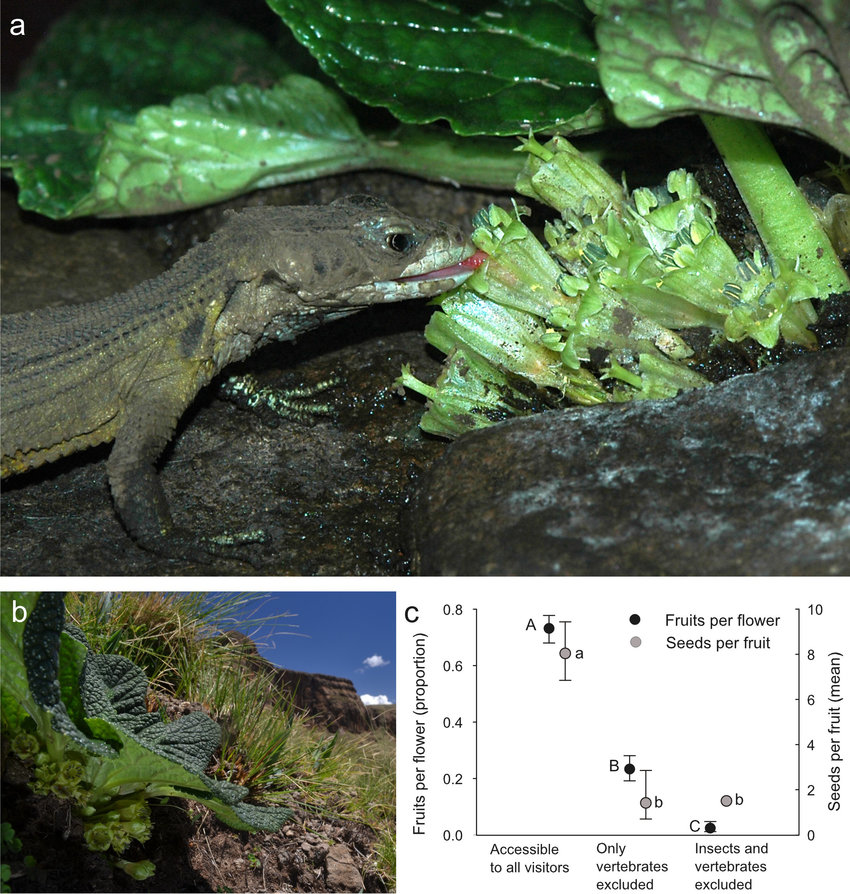
Finally, while the team was reviewing video footage, Johnson spotted a tiny little lizard in the background near the flowers. The 26-centimeter Drakensberg crag lizard (Pseudocordylus subviridis) is widespread in the Drakensberg region. That could only mean one thing. This lizard was a pollinator.
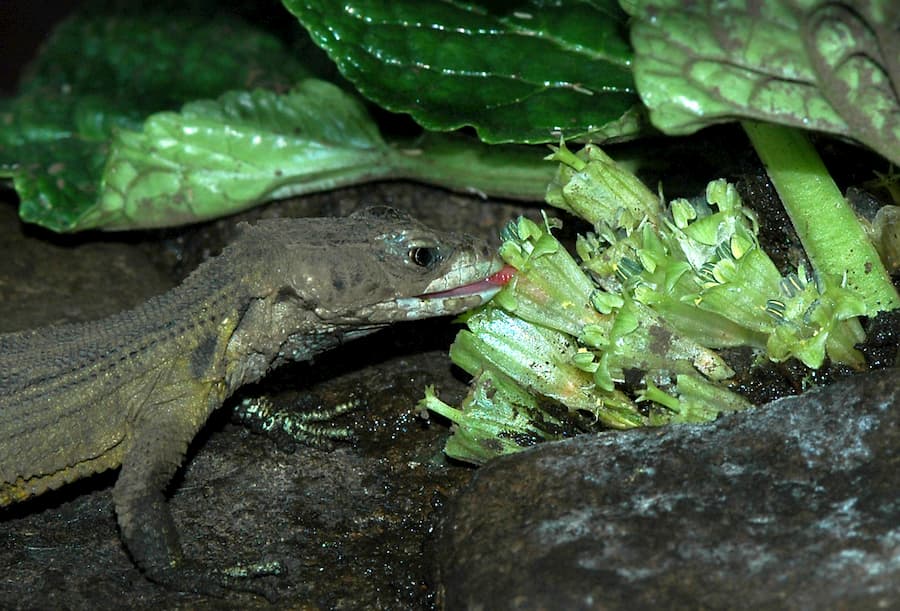
The team was surprised to discover a lizard pollinating these flowers. Lizard pollination is, according to Corzion, “among the rarest and most poorly understood pollination systems globally.” A recorded observation of the lizard was done only in 1977, on a small Portuguese Island. It was observed that the lizard was sipping the nectar from the flower. The discovery on the island was nothing new since more than 40 species of geckos and lizards were doing the same on the island.
Lizards are reptiles, which means they are cold-blooded, so the heat-sensing setting on the camera did not work effectively in spotting the lizard in the previous days. More footage of the lizard pollinating the flower and sipping the nectar occurred in the later days.
It was concluded that the lizards were carrying the Guthriea pollen on their smooth, scaly snouts, confirming that they are indeed the pollinator.
The scientists confirmed that the lizards were pollinators upon seeing them carrying pollen. When lizards were removed from plants in one experiment, the amount of seeds produced reduced substantially, by about 95%. Though lizards visit flowers, they almost exclusively do so on oceanic islands, and the significant involvement of lizards in G. capensis reproduction is nearly unparalleled.
The next mystery to be addressed is how lizards discover the “Hidden Flowers.” The majority of lizards eat insects. They may develop a sweet appetite and supplement their insect meals with sips of nectar in the harsh conditions of islands, deserts, and high mountains. Lizards use aroma to seek food, and a chemical analysis of the scent emitted by the “Hidden Flowers” uncovered chemicals that are nearly rare in the plant world. These unusual aroma compounds appear to be crucial in attracting the lizard.
Corizon and her team are still trying to discover the endless questions about this relationship, like what floral traits or physical characteristics attract the lizards to the flower; as we know, honey bees are partly attracted to a flower due to the ultra-violet bullseye they see in the center. Many scientific observations have not been made about this topic because of the inaccessible locations where lizard pollination occurs.
Their findings were published in the journal Ecology.
“‘Gobsmacked’” is probably the most appropriate word to describe us when we saw the first footage,” said Ruth Cozien, the paper’s primary author. ” We were aware lizards occasionally visit flowers on islands, and we knew that lizards are very abundant where Guthriea occurs. They both have a preference for rocky, high elevation habitats. We never put two and two together because it simply never occurred to us that a plant in continental Africa would be pollinated by lizards.”
Because of this confirmed case of lizard pollination in South Africa, thousands of pollination scientists now can answer all these lingering questions about lizard pollination while possibly discovering the unknown answers to the relationship between honeybees and flowers.
 Bee The Change